

Uganda Big 5 Safaris: Your Complete Guide to Africa’s Most Iconic Wildlife in the Pearl of Africa
Bujuku Eco Tours2026-07-22T11:56:13+03:00Uganda Big 5 Safaris: Your Complete Guide to Africa’s Most Iconic Wildlife in the Pearl of Africa: Uganda has lions, leopards, elephants, buffalo, and rhino. The country had all five before the political chaos of the 1970s and 1980s devastated wildlife populations across the region. Today, four of the Big Five lion, leopard, elephant, and buffalo roam freely across three major national parks, and the rhino is back, tracked on foot at Ziwa Rhino Sanctuary. A properly planned Uganda Big 5 safari lets you see all five, spread across two or three destinations, within a single connected trip.
What Uganda adds to the Big 5 experience that no other East African country can match is context. You see the tree-climbing lions of Ishasha a behavior found almost nowhere else on earth. You track white rhinos on foot through open grassland rather than watching them from a vehicle. You watch elephants move through the forest edges of Kibale, not just the savannah.
You do this without the vehicle congestion that crowds the sightings at more famous destinations. And you can combine the entire Big 5 circuit with gorilla trekking and chimpanzee tracking, creating the most diverse single-country wildlife itinerary available anywhere in Africa.
The Uganda Big 5 Animals
The African Lion
Lions in Uganda are found in three national parks Queen Elizabeth, Murchison Falls, and Kidepo Valley and each park produces a different quality of lion encounter. Queen Elizabeth is where most visitors have their first Uganda lion sighting, and it is where the most famous lion behavior in East Africa plays out.
The Ishasha sector of Queen Elizabeth National Park, in the park’s extreme south near the DRC border, is home to a sub-population of lions that has developed the unusual habit of resting in fig trees. It is one of two places in the world where this is consistently observed the other is Tanzania’s Lake Manyara. No one has fully explained why the Ishasha lions climb. The most accepted theories are that the elevated position provides relief from the heat and biting insects at ground level, and that the height gives better visibility over the Kob herds moving through the sector. Whatever the reason, finding a tree with four or five lions draped across its upper branches regarding your vehicle with the same unimpressed calm that lions exhibit at ground level is a sighting that silences even the most experienced safari travelers.
In Murchison Falls National Park, the lions work the open Buligi plains on the northern bank of the Nile. This is classic savannah lion territory large prides using the Borassus palm woodlands as ambush cover, hunting Uganda Kob and oribi on the open grassland. Morning game drives at Murchison, departing the Paraa ferry before 7am, give you the best chance of catching a pride still active after a night hunt. The lions here are less famous than Ishasha’s tree-climbers but often easier to find and frequently more behaviorally interesting you are more likely to witness hunting attempts, pride interactions, and cubs in Murchison’s more open terrain.
Kidepo Valley in the far northeast has the most remote and least-visited lion population in Uganda. The lions here are less habituated to vehicles than those in Queen Elizabeth and Murchison encounters feel rawer and less managed. The Narus Valley in Kidepo concentrates wildlife during the dry season, and lions hunting the large buffalo and Kob herds at the valley water sources produce some of the most dramatic predator sightings available in Uganda.
The African Leopard
The leopard is the most widely distributed large cat in Africa and the one least seen on safari despite being almost everywhere. It is solitary, secretive, primarily nocturnal, and expert at disappearing into terrain that offers almost no cover to any other large predator. In Uganda, leopards are present in every major wildlife park, but seeing one requires a combination of timing, local knowledge, and the specific kind of patience that comes from understanding what you are looking for.
Queen Elizabeth National Park, and particularly the Kasenyi Plains area, is where Uganda’s most consistent leopard sightings occur during daylight hours. The plains here are open enough that a leopard resting in the grassland is visible to a careful spotter, and the rocky outcrops and trees along the Kasenyi road give leopards their preferred combination of cover and elevation. Dawn and dusk are the reliable times the leopard is active in the transition hours, either returning from a night of hunting or beginning an evening foray before full dark.
Night game drives in Queen Elizabeth’s permissible areas are the best single strategy for leopard sightings in Uganda. The leopard that is invisible in the grass at noon becomes clearly visible in a spotlight beam at 9pm, its eyes reflecting from the edge of a thicket or its spotted coat catching the light as it crosses the road. Guests who have done both daytime and night game drives in Queen Elizabeth consistently report night drives as the better leopard opportunity.
Murchison Falls and Kidepo Valley both have leopard populations. In Murchison, the riverine woodland along the Nile is prime leopard habitat the dense vegetation provides cover and the river draws prey. In Kidepo, the rocky hillsides along the valley edges are classic leopard territory, and the park’s isolation means the leopards are less pressured by human activity than in more visited parks.
The leopard is the Big 5 member you might not see on every safari day, and that is part of its value. A leopard sighting in Uganda is earned rather than expected, and the moment when you find one draped over a branch in the middle-day heat with a kill hanging from the branches above, regarding the vehicle with absolute indifference is the kind of wildlife moment that stays with you precisely because of its rarity.
The African Elephant
Uganda’s elephants are among the most impressive and most accessible of the Big 5. The country’s major wildlife parks hold large, healthy elephant populations and the encounters available from game drive sightings on the open Buligi plains of Murchison to elephants drinking from the Kazinga Channel at water level from a boat are among the most varied elephant experiences available in East Africa.
Murchison Falls National Park holds Uganda’s largest elephant population estimates suggest over 1,300 individuals in the park, ranging across the northern game drive territory and the forest edges of the southern Budongo section. The elephants at Murchison are large-bodied animals with a notably relaxed attitude toward vehicles, which allows extended and close observation of herd behavior. The Buligi plains in the morning produce elephant sightings almost without exception herds of twenty to fifty moving to water, bulls alone at the edge of the woodland, family groups with calves moving across the open ground with the unhurried authority that only elephants carry.
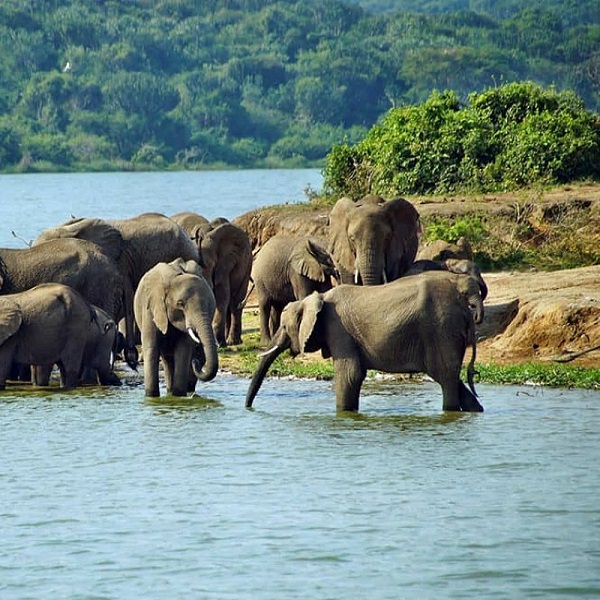
The boat cruise from Paraa to the base of Murchison Falls is Uganda’s most distinctive elephant experience. You approach elephants from the water, at their eye level, as they stand chest-deep in the Nile to drink and cool themselves in the morning heat. A bull elephant standing in the Victoria Nile with the falls audible in the distance behind him is one of the most photogenic scenes in all of East African wildlife photography, and it is not a staged or managed encounter it happens because this is what elephants do on this river every morning.
Queen Elizabeth National Park’s elephants have a different character from Murchison’s. The park’s higher rainfall and more varied terrain produce a population that moves between savannah, forest edge, and wetland throughout the day. The Kazinga Channel is the best single location for elephant viewing in Queen Elizabeth enormous numbers of elephants come to drink and bathe along the channel shores, sometimes in groups of a hundred or more, and the boat safari puts you within meters of them on the water.
The Cape Buffalo
The Cape buffalo has a reputation that precedes it significantly old-school hunters called it the most dangerous of all African game, more likely than any other species to circle back and ambush a pursuer when wounded. In Uganda today, the buffalo is not being pursued by anyone except photographers, and the herds across the major parks are an extraordinary wildlife spectacle in their own right.
Buffalo are present in enormous numbers across Uganda’s three main Big 5 parks. The herds at Murchison Falls and Kidepo Valley can reach into the hundreds dark, dense aggregations of animals moving across the savannah with a collective weight and momentum that is genuinely impressive to watch from a safe vehicle. A large buffalo herd crossing the road in front of your vehicle is not a subtle experience. It is a physical event that takes time to pass and produces a noise hoof, grunting, the crack of horns that carries across the landscape.
In Kidepo Valley, the buffalo herds are particularly large and the park’s isolation gives encounters with them a rawer quality than the more-visited parks to the west. The Narus Valley buffalo sometimes numbering in the thousands during the dry season when they concentrate around permanent water is one of the most dramatic large mammal spectacles available in Uganda.
The Southern White Rhinoceros
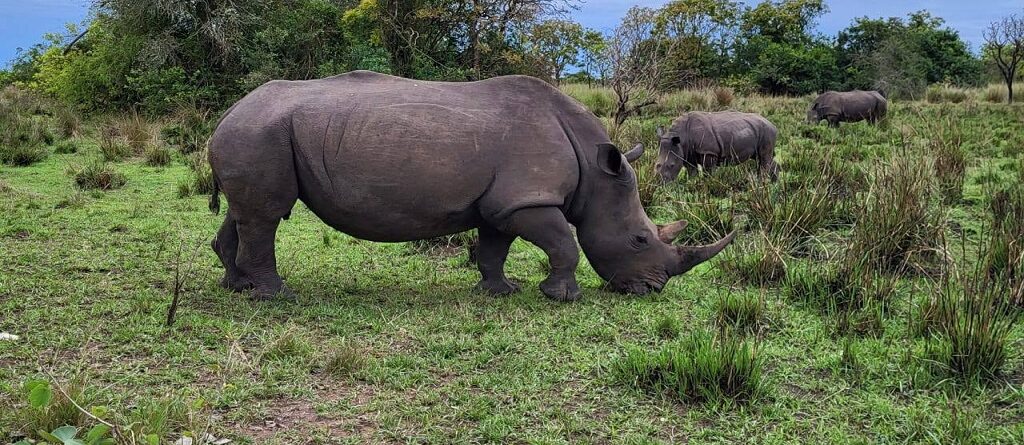
The rhino is where Uganda’s Big 5 story becomes genuinely moving, because the rhino should not be here at all. Southern white rhinos were hunted to local extinction in Uganda during the late 1970s and 1980s, victims of the political violence and institutional collapse that devastated the country’s wildlife during those decades. By the time stability returned, the rhinos were gone.
Their return is a conservation story worth knowing. In 2005, Uganda Wildlife Authority and the Rhino Fund Uganda imported six southern white rhinos from Kenya under strict biosecurity protocols, housing them at Ziwa Rhino Sanctuary a 7,000-hectare private ranch midway between Kampala and Murchison Falls. The sanctuary operates under 24-hour armed ranger protection. The rhinos have bred steadily. As of 2025, the Ziwa population numbers over 50 individuals, and the long-term plan is to eventually reintroduce rhinos to Uganda’s national parks once populations are large enough to sustain it.
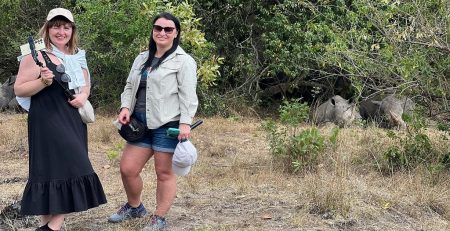
The Ziwa rhino tracking experience is different from any other Big 5 encounter in Uganda and in East Africa. You are on foot. Your ranger team locates the rhinos through daily monitoring and radio communication.



Leave a Reply