


Where to See Mountain Gorillas in Africa
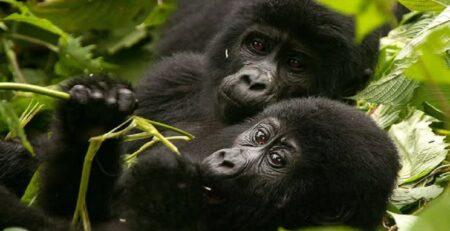
Bujuku Eco Tours2026-07-03T12:40:08+03:00Where to See Mountain Gorillas in Africa: Mountain Gorillas are found in Uganda, Rwanda, and the Democratic Republic of Congo. There is no mountain gorilla habitat anywhere else on earth. The entire species occupies a remarkably small area, and the parks that protect them. Mountain gorillas (Gorilla beringei beringei) are a critically Endangered subspecies of the Eastern gorilla, with just over 1,063 individuals remaining entirely in the wild. They live in high-altitude, misty montane and bamboo forests at elevations between 8,000 and 14,000 feet, making them uniquely adapted to freezing temperatures. Notably, mountain gorillas cannot survive in captivity, meaning the individuals protected within these specific African jungles are the only ones left on Earth.

Mountain Gorilla in Uganda
Bwindi Impenetrable National Park
Uganda holds slightly over half of the world’s remaining mountain gorillas, the largest share of any country. Most of them live in Bwindi Impenetrable National Park, a UNESCO World Heritage Site covering 331 square kilometers of montane and lowland forest in southwestern Uganda.
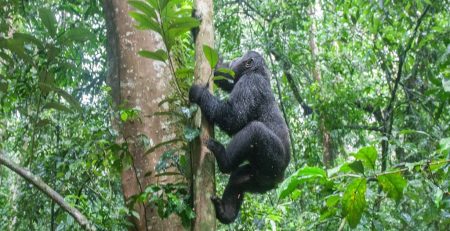
The park’s name comes from the Runyakitara word Mubwindi, meaning dark place, and if you have walked through its interior, you understand why. The forest is dense, layered, tangled, and in places genuinely difficult to move through.
Bwindi is also one of Africa’s most biodiverse forests, with over 120 mammal species, more than 350 bird species, 220 butterfly species, and 10 species of primate.
There are four main trekking sectors within Bwindi: Buhoma in the north, Ruhija in the east, Rushaga in the south, and Nkuringo in the southwest. Each sector has its own habituated gorilla families, its own lodge infrastructure, and its own character. Buhoma is the oldest and most established sector and has the widest range of accommodation close to the park. Rushaga has the most habituated families of any sector and is a good option for visitors booking at shorter notice. Ruhija sits at higher altitude, which makes the mornings cold and the forest particularly atmospheric. Nkuringo is the most remote of the four and has a small but loyal visitor following.
A gorilla trekking permit in Uganda costs USD 800 for foreign non-residents and USD 700 for foreign residents. East African citizens pay USD 80. The permit allows one hour with a habituated gorilla family. Uganda is also the only country in the world where the Gorilla Habituation Experience is available, a four-hour visit to a semi-habituated family that is still in the process of becoming accustomed to human presence.
This permit costs USD 1,500 and is only available at certain groups in the Rushaga sector. Trekking in Bwindi is generally more physically demanding than in Rwanda. The forest is steep, thick, and unpredictable in its terrain, and finding the gorillas can take anything from forty minutes to a full day. That unpredictability is part of what makes Bwindi memorable.
Mgahinga Gorilla National Park
Mgahinga located in Uganda’s far southwest corner, on the slopes of three Virunga volcanoes: Muhabura, Gahinga, and Sabyinyo.
It is the smallest national park in Uganda, covering just 33.7 square kilometres, and it has only one habituated gorilla family: the Nyakagezi group, which moves between Uganda, Rwanda, and the DRC with no regard for the international borders below it. When the family is in Uganda, trekking is available. When they cross into Rwanda or the DRC, the park’s gorilla trekking closes temporarily.
This means Mgahinga is best booked with some flexibility and is generally recommended as a secondary option to Bwindi rather than a primary destination. The park is also home to golden monkeys and offers hikes on its three volcanoes, including a summit hike to Mount Muhabura at 4,127 metres.
Mountain Gorillas in Rwanda
Volcanoes National Park is situated in the northwest of Rwanda, two and a half hours by road from Kigali. It protects the Rwandan section of the Virunga Massif, covering six volcanoes including Mount Karisimbi at 4,507 metres and Mount Bisoke at 3,711 metres.
The park has twelve habituated gorilla families available for trekking, and 96 permits are issued per day, with eight visitors allowed per family per session.
The trekking begins at the Kinigi briefing point at 7:00 AM, and groups are assigned to gorilla families based on the previous day’s tracking data, trekker fitness, and difficulty preferences.
Rwanda is the most accessible country for gorilla trekking in terms of logistics. Kigali International Airport has direct connections from most major European and African hub cities, and the road to the park from the capital is sealed and straightforward.
Many visitors book a same-day transfer from Kigali, arriving at a lodge near Musanze the evening before their trek and returning to Kigali the following afternoon. That makes Rwanda practical for travelers on tighter schedules who want to include a gorilla trek without committing to a longer African safari itinerary.
The gorilla permit in Rwanda costs USD 1,500 per person for international visitors, making it the most expensive gorilla trekking permit in the world. The price is intentional. Rwanda positions itself as a high-value, low-impact destination, and the permit revenue supports conservation, ranger salaries, and community development around the park. East African Community nationals pay USD 200, and a low-season promotional discount to USD 1,050 is available for visitors combining the gorilla trek with at least two nights in Akagera or Nyungwe National Parks.
Dian Fossey, whose research at Karisoke Research Centre in the park from 1967 until her death in 1985 brought international attention to mountain gorillas, is buried near her research site inside the park.
The Ellen DeGeneres Campus of the Dian Fossey Gorilla Fund, opened in 2022 near Musanze, is open to visitors and covers the history of gorilla conservation in the Virunga and the continuing research work in the park.
Mountain Gorilla in Democratic Republic of Congo
Virunga National Park
Virunga National Park is Africa’s oldest national park, gazette in 1925, and it covers 7,800 square kilometers of the eastern DRC. The park holds eight habituated mountain gorilla families and, when operational, offers the cheapest gorilla trekking permit of any country at USD 400 per person.
It is also the only place where gorilla trekking can be combined with a hike to the active summit crater of Mount Nyiragongo, a volcano with a persistent lava lake at its peak that is one of the most dramatic hiking experiences in Central Africa.
Virunga has, however, been closed to tourists repeatedly due to security concerns in the eastern DRC. The park was closed from March 2020 and only partially reopened in limited areas in subsequent years.
The security situation in North Kivu province, where the park is located, has been unstable for decades, with armed group activity in areas bordering the park. Before considering any visit to Virunga, check the current travel advisories from your government and the specific security situation in the park at the time of travel. When open and safe, Virunga is a remarkable destination. When it is not, it is not worth the risk.
Kahuzi-Biega National Park
Kahuzi-Biega is the only place in the world where you can track eastern lowland gorillas, Gorilla beringei graueri, a different subspecies from the mountain gorillas found in the Virunga and Bwindi.
Eastern lowland gorillas are the largest gorilla subspecies, and around 250 remain in Kahuzi-Biega. The park is located in South Kivu province, south of Virunga, accessible from the town of Bukavu on Lake Kivu.
Bukavu is reachable by flight from Kigali, which makes Kahuzi-Biega the more accessible DRC gorilla destination for most visitors. The park is less stable than Uganda or Rwanda but more accessible than Virunga, and it offers a gorilla encounter that is genuinely different from the mountain gorilla experience in the Virunga.
Comparing Your Gorilla Trekking Options Between Uganda, Rwanda and DRC
Most people choosing between gorilla trekking destinations narrow it down to Uganda versus Rwanda and make the decision on a combination of budget, logistics, and what else they want to do on the trip.
Rwanda costs almost twice as much as Uganda for the same one-hour gorilla encounter. In exchange, you get easier logistics: a shorter drive from a better-connected international airport, shorter trek distances in most cases, and accommodation that sits at the high end of the East Africa market.
Rwanda works well for visitors on tighter schedules, those combining the trek with a broader East Africa itinerary who cannot spare the extra days that Uganda’s longer transfers requires, and those travelling in a group where some members are less physically confident about long, steep hikes through dense forest.
Uganda works better for visitors with more time, lower budgets, or a strong interest in combining gorilla trekking with other activities. After Bwindi, the options are considerable: chimpanzee trekking in Kibale Forest, white-water rafting on the Nile at Jinja, boat safaris in Queen Elizabeth National Park, the Rwenzori Mountains, and Murchison Falls. Uganda is also where the Gorilla Habituation Experience is available, and for visitors who want more than one hour with a gorilla family, this is the only country where that option exists.
The DRC is the choice for adventurous, experienced Africa travelers who have already done Uganda and Rwanda and want something further off the standard circuit. The eastern lowland gorillas at Kahuzi-Biega are found nowhere else, and the combination of Virunga’s mountain gorillas with a Nyiragongo volcano summit when the park is operational is one of the most unusual safari experiences available in Africa. The security situation requires careful monitoring, and travel insurance covering emergency evacuation is non-negotiable for any DRC trip.

Leave a Reply